The Role of Religious Leaders in Education
Shinto Misogi-kyo — Rev. Yasuhiro Sakata, Chief Priest
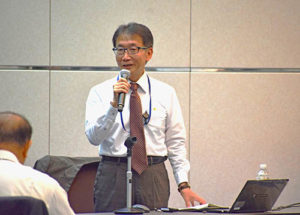
Interview with Rev. Yasuhiro Sakata, Seventh Head of the Shinto Misogi-kyo Main Family
(Interview by Koichi Tanaka)

Japan today faces a society where many problems have become normalized. There is an urgent need to rebuild the nation’s educational foundation. Rev. Yasuhiro Sakata, Chief Priest of Shinto Misogi-kyo, emphasizes that for Japan to continue being a “morally advanced nation,” religious leaders must adopt historical and long-term perspectives and engage in education that only religious leaders can provide.
Reviving the Way of the Divine
— To begin, could you briefly introduce the teachings of Shinto Misogi-kyo?
The founder of Shinto Misogi-kyo, Master Masakane Inoue, during the turbulent closing years of the Edo period, for the realization of a world where all living beings are saved and dwell in peace, established our faith with the great vow of “reviving the Divine Way (Jingi Daidō) to restore the true spirit of Yamato.” The “Divine Way” means to perceive the will of the hidden Divine Being, make that divine will the upright axis of one’s soul, and live together with the Divine. The realization of a “world of salvation and peace for all living beings” means a world where society prospers, all life is delivered from suffering, and people live together in serenity—just as the deity Izanagi declared: the true land of Yamato, the “Land of Ura-yasu,” a land of peace and harmony. It is not only about human beings—animals, plants, water, air, and all things coexist, co-live, and co-flourish.
In our teaching, such words are read in native Japanese rather than in Sino-Japanese readings. For instance, we read “存” as tamotsu (to preserve), “生” as ikiru / ikasu (to live / to make live), and “栄” as sakaeru (to flourish). Thus the phrase becomes “to preserve together, to live and let live, to prosper together.” The meaning deepens when expressed in our native language.
The Spirit of “Hataraku” — Working for the Sake of Others
Our faith teaches that the Japanese people are a “hataraku” (働く / 傍楽) people—those who “work for the joy of others.” The spirit of hataraku literally means “to move for the sake of others,” “to act wholeheartedly for those around us.” It is compassion, consideration, and empathy. That, I believe, is the true national character of Japan.
To work in this sense is not something extraordinary. If one acts out of spontaneous compassion, always mindful of others’ hearts, and prays that their pain or sorrow may be eased even a little, then any activity—whether by a child or an elder—becomes hataraku, an act of sacred work. Such was the teaching of our founder.
To live this hataraku way of life, one must maintain purity of body and mind. Actions born of voluntary restraint and moral consciousness are required. This is a trait unique to our people. Our faith teaches and practices the “Inner Purification (Uchi-Seijo) Misogi,” the only means for the “revival of destiny,” carried out through the “one-breath misogi.” As a path of study, we have the “Teaching of the Mirror,” and as a path of practice, we follow the “Five Essentials of Hidden Virtue” (repentance, selfless resolve, study, frugality, and gratitude to the origin) and “dietary cultivation.” The Founder’s teaching—“With one bowl of rice, I offer to save the hungry”—has evolved into the global “One Meal Donation Movement,” now embraced as an international campaign within religious circles.
Education Must Be Grounded in History
— From the standpoint of education, these are profound insights. How do you view the role of religious leaders in education?
Religion and education are inseparable. Religious leaders must constantly pay attention to educational issues and national education policies. I believe that it is by stepping right into the heart of such issues that religion can truly fulfill its original mission. The problem arises when we view the present moment only through a fleeting or subjective lens. We must take an objective, panoramic, and long-term view. Education is a process of accumulation over time.
In the Edo period, Japanese moral thought was grounded in Confucianism—the Five Constants of benevolence, righteousness, propriety, wisdom, and faith. To these, Japan added four additional virtues: loyalty, filial piety, fraternity, and chastity, thus creating a “culture of harmony.” Recognizing that this moral foundation is what gained Japan the world’s respect is essential to envisioning the future of education. Sadly, current educational reforms debated in the Diet seem to have lost this historical perspective.
That is why religious leaders today must bring such a viewpoint to their work. This is the reason I established the study group Gyōshō-juku (“Academy of the Dawn Bell”). Since my twenties, I have lectured widely on the Analects, Great Learning, Doctrine of the Mean, Buddhist scriptures, and the Tannishō (A record of Shinran’s teachings in Pure Land Buddhism), providing opportunities to help modern Japanese rediscover their lost identity. We have studied the Seventeen-Article Constitution, the Imperial Rescript on Education, the significance of Yasukuni Shrine, and Kojiki (“Records of Ancient Matters”— Japan’s oldest chronicle of myths and early history) lectures. At times, I have invited guest lecturers to teach from the perspective of traditional Japanese performing arts. Although activities were temporarily suspended due to the pandemic, I remain committed to preserving and transmitting the spiritual core of Japan’s cultural heritage.
Educational Achievements of the Edo Period
Seen from this perspective, education in the Edo period was truly remarkable. In terakoya (temple schools in the Edo period that provided basic education to commoners) schools, children were thoroughly taught reading and writing, and even elementary-aged children could recite the Analects, Great Learning, and Doctrine of the Mean. The results are evident in literacy statistics: an unprecedented rate in world history—around 70–80% in cities and about 60% nationwide, including rural areas. This high literacy became the driving force behind Japan’s rapid modernization after the Meiji Restoration.
An episode illustrates the Japanese spirit vividly. In the mid-16th century, when Christian missionary Francis Xavier visited a village, a farmer asked him: “If the God you speak of is so great, why did my parents and grandparents not know His name?” Xavier replied according to his faith: “Those unbaptized cannot be saved.” The farmer then said, “Then your God is cold. If my ancestors cannot be saved, then He is not our God. If my parents and grandparents are in hell, I will gladly go to them.” Xavier was astonished by this response. The farmer spoke not with logic, but with his heart, valuing existence together with his ancestors. Xavier later recorded, “I have never met such noble heathens as the Japanese. They possess both reason and decorum, and even without knowing God’s name, they carry prayer in their hearts.”
Japan has long cultivated a devout, sincere, and steadfast way of life—something deeper than scholarship or educational theory. This is where we religious leaders must engage.
Japan as a Morally Advanced Nation
After the Meiji Restoration, Japan, under the philosophy of wakon yōsai (“Japanese spirit, Western learning”), rose to the ranks of world powers in just a few decades. This success owed much to the nation’s spiritual culture and high literacy—products of terakoya education—and to a society that saw children as “heaven’s gifts,” with everyone sharing responsibility for their upbringing.
After the war, under the banner of democratization, movements arose that denied Japan’s own traditions. The result was moral decline, excessive individualism, and a culture of competition. What Japan must value above being a “technological” or “tourism” nation is being a morally advanced nation. Moral education is precisely where religious leaders should devote their efforts.
Without a historical perspective, fundamental educational reform is impossible. True reform may be difficult to achieve solely within schools. Because education requires continuity, it is the religious leaders—whose mission is also continuous—who must take initiative. This does not mean teaching sectarian doctrines, but rather, through the lens of religion, teaching how to live as human beings and as members of society.
Five Challenges for Modern Education
— Especially today, we must not lose sight of history. As a religious leader, what specific reforms do you propose?
I see five key areas for reform:
1. History education
2. Japanese language education
3. Emotional and moral education
4. Religious education
5. Cultural education
1. Deficiency in Modern History Education
For example, the lack of instruction in modern and contemporary history is a serious problem. Ignorance of one’s modern history leads to an unstable sense of identity and deprives people of the foundation to understand contemporary society. This ignorance contributes to the polarization, instability, and confusion of modern politics.
History begins with myth. The historian Arnold Toynbee once said, “Every civilization that failed to teach its children their national myths by age 12 or 13 has perished without exception.” Myth is the very source of culture.
2. Language Is Culture Itself
In regard to Japanese language education, I feel that people fail to recognize that language is culture itself. The sound and rhythm of Japanese carry culture within them—this is our identity. Humanity resides in words. These have been inherited across generations; they do not belong only to individuals living today. Modern society tends to neglect this too easily. There are things that can only be expressed in Japanese. It is a uniquely rich language—with five character systems: kanji (both on-yomi and kun-yomi), hiragana, katakana, and ruby (furigana). The decline of respectful language (keigo) is worrying, for harmony in society is maintained through language. Such cultural practices must be preserved and passed on.
Emotional education is also lacking due to excessive competition and an overemphasis on intellect. Yet the word yūshū(excellence) includes the character for “kindness” (yū). To know others’ feelings and act with compassion leads to diversity and tolerance. To feel others’ hearts requires vocabulary—linguistic and cultural literacy.
3. Understanding What Religion Truly Is
Since the war, the phrases “freedom of religion” and “separation of religion and state” have been misunderstood, resulting in an anti-religious climate. Few teach that faith means to hold a reverent heart toward a power greater than oneself and to strive to approach it. If humanity rediscovered this origin, there would be no more religious wars—only collective efforts to ascend to higher realms. Such education is missing today.
We must teach what religion is—the history of Buddhism, Christianity, Islam; the lives of dedicated religious figures; and the meaning of jinja (Shinto Shrines) and Kyōha Shintō (Sectarian Shinto). A certain American scholar of religion said, “Religion is humanity’s ultimate concern.” Therefore, schools must teach the essence of religion itself.
4. Education in Myth and Culture
Education in myth is truly vital. In 2006, before the 1300th anniversary of the Kojiki’s compilation, the first Abe administration revised the Basic Act on Education. In 2008, national curriculum guidelines were amended so that Japanese myths would appear in elementary textbooks. In 2009, I published Yomitoki Kojiki (“Interpreting the Kojiki”), explaining that it is not mere mythology but a treasury of wisdom guiding humanity toward moral perfection.
Cultural education, too, is essential—but it is poorly taught today. Japanese culture is one of feeling—of mutual empathy. Hence our silent greetings, our reverence for pauses and spaces, and our acceptance of diversity. Yet traditional annual observances such as Oshogatsu(New Year’s), Shichi-Go-San (“Seven-Five-Three”— a traditional celebration in Japan where families visit shrines to pray for the healthy growth of children aged three, five, and seven), or Obon(a Japanese Buddhist festival in August honoring ancestral spirits, featuring grave visits, dances, and lantern ceremonies) are no longer properly understood. How many Japanese can explain their meaning? Each festival day carries history and culture. When Japanese can no longer explain their own culture, that culture is already on the verge of death.
Education That Only Religious Leaders Can Provide
Japan, where many problems have become entrenched, must seriously reconsider its educational foundations. For the nation to remain a “morally advanced country,” we must break down the walls of discrimination and prejudice that arose after the war, and people of all walks of life must join hands. Religious leaders, in particular, must engage in the kind of education that only they can provide.
Yasuhiro Sakata — Profile
Born in 1962 as the eldest son of the Head Family of Misogi-kyo. Educated at Gakushuin Elementary, Middle, and High Schools; graduated from Gakushuin University, Faculty of Letters, Department of Philosophy. At age 13 (in 1975) he succeeded to the position of Chief Administrator of Misogi-kyo; in 1988 he formally declared the succession as the Seventh Head of the Shinto Misogi-kyo Main Family. He has since worked tirelessly for the revival of the true Misogi faith—heir to the Shirakawa Hakuke royal priestly lineage—and for the restoration of the spiritual essence of the Yamato (Japan) people, the revival of ancient rituals, and the transmission of Japan’s mythological tradition.
His major works include Contemporary Norito Commentary, Guide to the Misogi Funeral Rite, The Teaching of Misogi, The Omichizuke Textbook (Misogi-kyo Shinpa Headquarters); Interpreting the Kojiki (Sankei Shimbun Publications, selected by the Japan Library Association); Collection of Shinto Path Songs (TEM Publishing); Collected Talks of the Chief Priest: Suzukaze (Misogi-kyo Headquarters); and Interpreting the Kojiki – Pocket Edition (Sankei NF Library).