Issues Surrounding the Family Federation Are a “Fabrication”
Commemorative Talk Event for the Publication of The Sacrifice of the State (Kokka no Ikenie) by Masumi Fukuda
Chiyoda Ward, Tokyo
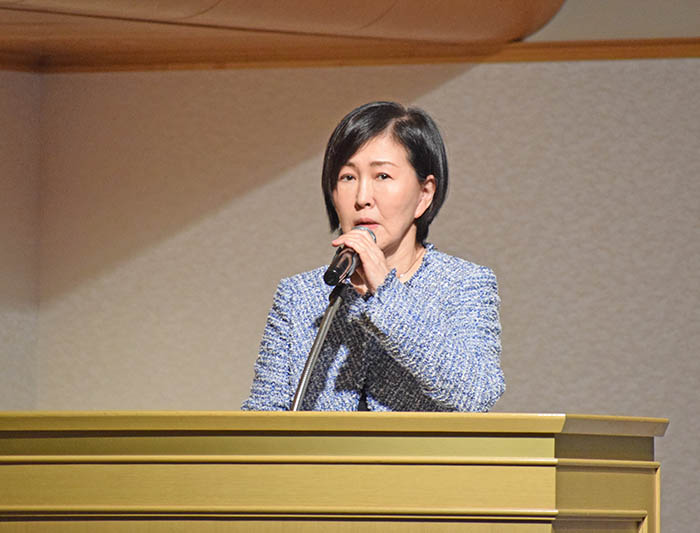
On December 22, a talk event commemorating the publication of The Sacrifice of the State, written by Masumi Fukuda, was held at a venue in Chiyoda Ward, Tokyo. The event was organized by the Association of Second-Generation Members for the Protection of the Human Rights of Believers Association of Second-Generation Members for the Protection of the Human Rights of Believers (represented by Kiaki Kojima). A large number of participants attended the event, and the venue was filled. Lively discussions took place on issues such as freedom of religion, the role of the media, and problems within the judiciary.
The event consisted of two parts.
In the first part, following the master of ceremonies’ opening remarks, Kiaki Kojima delivered an address on behalf of the organizers. Kojima expressed gratitude to the author, Fukuda, for carefully examining the background and truth of the case through her book, explaining that it was this conviction that led to the planning of the event.
After the introduction of guests, Kazuyoshi Hanada, President of Asuka Shinsha, the publisher of the book, took the stage. He emphasized that The Sacrifice of the State is an extremely important work for safeguarding freedom of religion in Japan. He further stated that the mainstream media (so-called “old media”) has completely ignored the widespread misunderstanding surrounding the principle of separation of religion and state, as well as the fact that the Family Federation has long criticized communism.
Next, literary critic Eitaro Ogawa delivered a recommendation speech, praising Fukuda’s determination by stating, “Continuing this series for three years required tremendous courage.” He added that the book should be read not only by members of the Family Federation, but especially by those outside the faith. “If the media is reporting something that is 180 degrees opposite from the truth, that in itself demonstrates how abnormal our society has become,” he said, expressing his hope that the book would reach as many people as possible.
Former House of Councillors member Satoshi Hamada stated that he had repeatedly raised questions in the National Diet regarding the issue of dissolving the Family Federation, and added that he had introduced the book on YouTube earlier that very morning, offering his strong endorsement.
Following this, the author Masumi Fukuda took the stage. She recalled her initial impressions from the start of her reporting, stating, “The Family Federation has long been portrayed as an ‘absolute evil,’ but when I actually met its members, I found many of them to be exemplary members of society.” She also reflected that she had very little knowledge of religion before beginning her research, but over the past three years had continued her reporting while learning for herself what religion truly is. She pointed out that Japanese society in general lacks understanding of religion, and that this has led to a significant gap in perception.
Fukuda further noted that even after completing the series, the widespread belief persists that members of the Family Federation are under mind control. She explained that an extremely negative image of the organization as a “bad religion” has been formed, and that this image has, in part, been deliberately implanted. She stated that her work has revealed, to a certain extent, the existence of forces seeking to portray the Family Federation as an absolute evil.
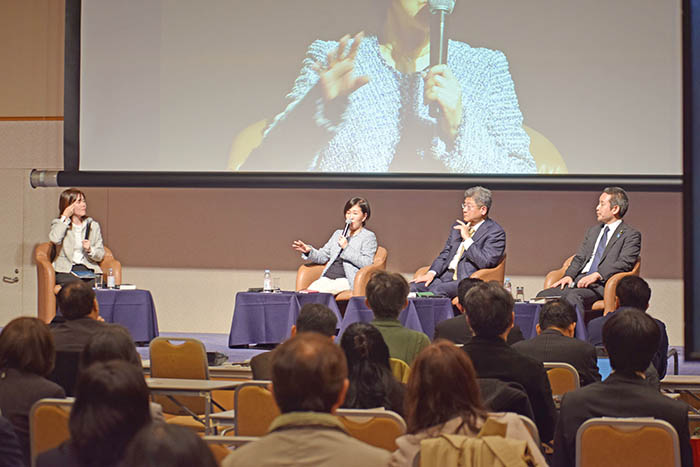
In the second part, a talk session was held, moderated by Kojima, featuring a panel discussion with Fukuda, Ogawa, and Hamada.
Fukuda remarked, “The mere fact that I attend events hosted by the Family Federation is treated as though it were a criminal act.” She stressed that while she wants the public to know the truth, the greatest obstacle standing in the way is the media. She also pointed out that the media refuses to report on the reality of abductions and confinement (targeting members of the Family Federation), or on the true nature of those who oppose such practices. Referring to her previous book Fabrication, which exposed how a Fukuoka elementary school teacher was falsely branded a “murderous teacher” by the media, she explained that while that case involved an individual, the issue surrounding the Family Federation represents a state-level “fabrication.”
Ogawa reflected on the 1970s, noting that during a period of intense confrontation between the political right and left, the International Federation for Victory over Communism expanded as a major movement uniting forces on the right. He pointed out that a sophisticated ideological struggle has been waged by attacking the religious organizations that supported the right.
Kojima stated that he initially believed the issue of second-generation members was merely a means of boosting television ratings, but gradually came to understand it as part of an ideological struggle. Hamada expressed a strong sense of crisis, warning that if a dissolution order were to be approved, it would effectively serve the intentions of terrorists. While acknowledging that the battle is difficult, he emphasized that it is not unwinnable. He also revealed that after questioning the dissolution of the Family Federation in the Diet, several lawmakers came to thank him, suggesting that many legislators privately share the same concerns.
Ogawa remarked that the tide is beginning to turn, stressing the need to properly understand the logic of freedom of religion. He suggested that one contributing factor is that publishing houses long trusted in Japan have “sold their souls.” At the same time, he offered a more positive assessment of the current situation, noting that although Prime Minister Takaichi is frequently criticized on television, her approval ratings have not declined, which demonstrates the rapidly diminishing influence of television media.
When Kojima raised the issue of being shocked by the fact that no hearings had been conducted with active believers, Fukuda responded that this was likely due to the widespread dissemination of the seemingly plausible theory that “believers are under mind control,” describing the method as extremely cunning. In response, Ogawa stated that although television may be the most harmful invention ever created by humanity, it remains important even within that environment to appeal to the appropriate people about the true situation.
Fukuda further argued that in the case of the Family Federation, the judiciary is entirely hostile. She criticized the district court’s reasoning regarding dissolution as sophistical and lacking sufficient evidence. She also referred to concerns expressed by United Nations special rapporteurs and others from the perspective of international human rights law regarding Japan’s response (as noted in an official press release by the Office of the United Nations High Commissioner for Human Rights dated October 1, 2025), concluding that the Family Federation issue exposes distortions within Japan’s judicial system.
In closing, Ogawa stated that behind the abnormality of the judiciary lies an extreme left-wing ideology that is now in its death throes. He emphasized the importance of mobilizing public opinion, and stressed that solid evidence, such as that presented in this book, is essential. Hamada echoed this sentiment, concluding the event by stating that although the struggle is severe, the tide is unquestionably changing.
Among the guests was Seishiro Sugihara, former professor at Musashino Women’s University, who praised the book for explaining not isolated incidents but the overall picture, noting its significant social impact. He emphasized that the publication of the book is of great importance, and added that the key outcome of the event was the shared recognition of the need to reveal to the public the true nature of those attacking the former Unification Church.